Breastfeeding-Safe Skincare: What Actually Transfers Through Milk
Good news: the nursing "avoid" list is much shorter than the pregnancy one. The questions change too — it's less about the placenta and more about what reaches breast milk, and what sits on skin your baby touches.
How nursing risk is different
During pregnancy, the concern is ingredients crossing the placenta during development. While nursing, two different routes matter: systemic absorption that reaches breast milk (usually tiny for topical skincare), and direct contact transfer — products on your chest, hands, and arms that end up on your baby's skin and mouth.
That second route is the one most articles miss, and it changes the practical advice: where you apply something can matter as much as what it is.
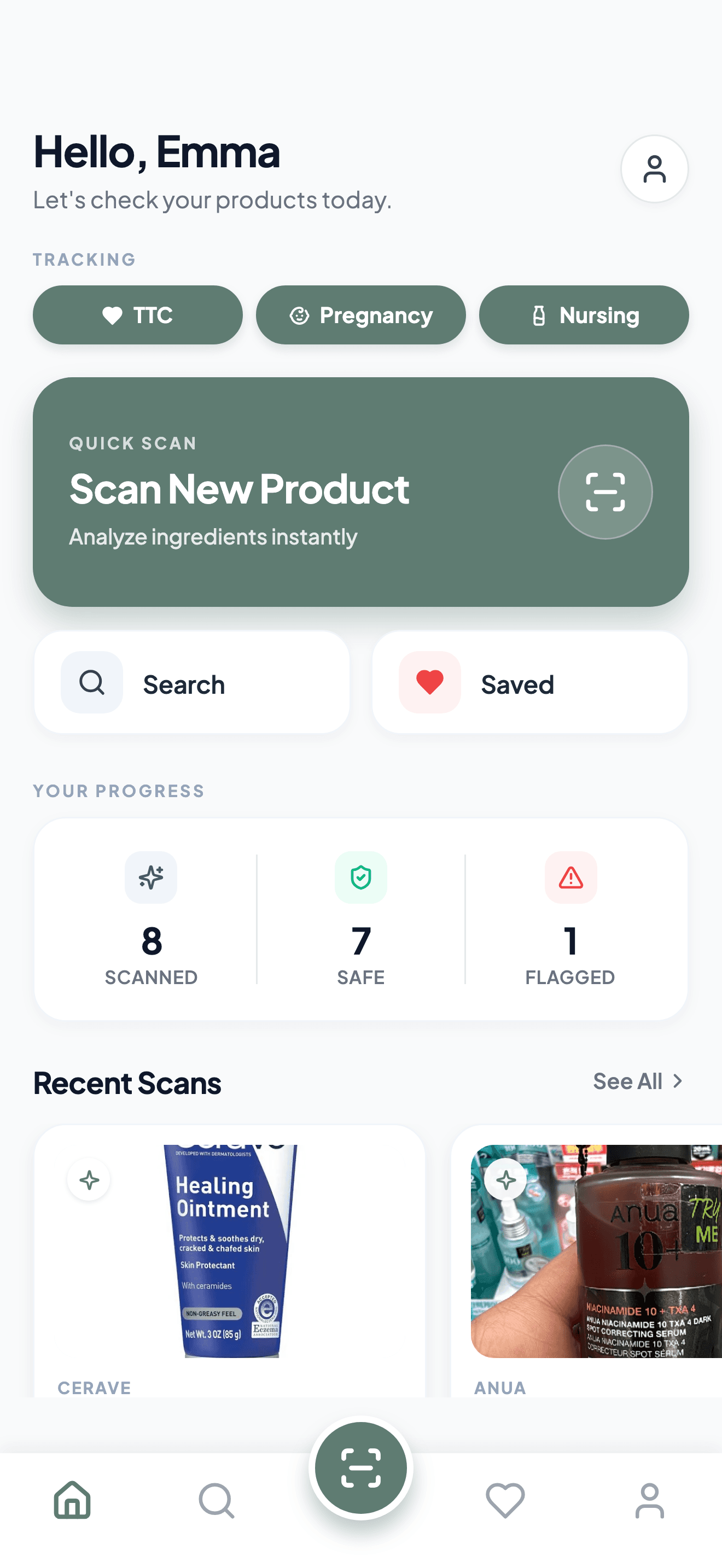
Faster than reading every label
Scan the product in BloomSafe and get a stage-specific score in seconds.
Built for TTC, pregnancy, and breastfeeding — beauty and food in one place.

Still worth avoiding or limiting while nursing
A short list survives from pregnancy:
- Prescription oral retinoids (isotretinoin) — still contraindicated
- Hydroquinone — high absorption makes it the cautious skip
- High-dose salicylic acid peels — standard OTC products are generally fine
- Anything applied directly to the nipple area without being wiped off before feeding (including some nipple balms with non-food-safe bases)
- Strong essential oils (e.g. peppermint in large amounts may affect supply for some women)
Frequently asked questions
Can I use retinol while breastfeeding?
Many providers consider OTC topical retinol acceptable while nursing because milk transfer is minimal — apply away from chest and hands, or stick to alternatives if you'd rather not weigh it. Prescription oral retinoids remain off-limits.
Do I need a special 'nursing-safe' product line?
No. Most regular products are compatible with breastfeeding. What you need is to know which specific ingredients to skip — which is a scan, not a shopping trip.
Keep reading
Related guides
Trying to Conceive: Ingredients That May Affect Fertility
Endocrine disruptors, retinoids and other ingredients worth phasing out while trying to conceive — what the evidence says, and what's just noise.
Read guidePregnancy-Safe Skincare: Ingredients to Avoid and Safe Swaps
Which skincare ingredients to avoid during pregnancy — retinoids, hydroquinone, high-dose salicylic acid — and the safe swaps dermatologists and OB-GYNs recommend instead.
Read guideRetinol While Pregnant or Breastfeeding: What the Science Says
Why retinol and other retinoids are flagged during pregnancy, what the research actually shows, which hidden ingredient names to watch for, and what to use instead.
Read guide